Archives For How can we find significance

A few years ago a client came into town for a series of meetings. He asked for a restaurant recommendation, and I suggested my favorite restaurant, The Gandy Dancer. The next day he came to my office Menuand raved about the restaurant. He was going to recommend it to every one of his colleagues.

I asked him what he’d ordered. “Nothing,” he said, he’d been too busy. But he had “stopped by and studied the menu, and everything looked incredible.”

I thought he was nuts.

But I’m beginning to think that most of us believers are equally “nuts.” We read the menu and miss the meal. We nourish our Christian lives by feasting on a cardboard menu of untasted truths.

The cardboard menu is a link to a spiritually nourishing banquet, but too often we simply chew on the cardboard. Is it any wonder our lives look like cardboard-cutouts?

Frankly, cardboard is neither life-giving nor nourishing. Even with a dash of salt.

The Christian life is more than the menu         Continue Reading…

A friend of mine challenged me to adopt—perhaps embrace—a Transcendent Pursuit for the coming year, something life changing, something I can bring to the world to make a difference.

Then I re-read the first chapter of Genesis. It felt like I was reading it for the first time, and I felt the nudge of God.

The first thing I noticed was the creative artistry of God. The opening verses do not focus on God’s unparalleled power. Instead they reveal—and almost revel in—the beauty.  After each creative act God doesn’t say, “That was powerful;” he says, creation+of+adam+michelangelo“This is beautiful” (a better translation than what we are used to).

Next I noticed that God sees potential where no one else ever could. God hovers over and looks into the chaos and void; he takes the raw materials of darkness and depth, and he creates light, and it is beautiful. As are the oceans and fields and skies.

After observation and creation, God gives. He gives this unparalleled treasure of creation to man. The opening chapter of the Bible surges with swarming fish, teaming land animals, luscious vegetation, and a sky pregnant with stars.

And God turns to man and says, “It’s yours. Take it. Care for it. Love it.”

The opening of the Bible reveals a completely different God than any man has ever created. The opening of the Bible reveals God as an artist, seeing beauty, creating incomparable art, and giving it away. It is a radical image of God.

I long to live like that artist

Continue Reading…

[To listen to a reading of this article, click here.]

Last Sunday night was a dark night. I woke in the dark, thinking dark thoughts, unable to stop my mind from wandering the shadowy paths of self-condemnation. I lay awake,

  • Remembering my unfulfilled promises to my kids when they were young,
  • Regretting my mistakes made as a boss to good employees,
  • Wondering if my life had made any difference for good in the world.

Sunrise came. I stretched and tried to shake off the phantom spirits of despondency. I looked for something to cheer me, something to help me forget the darkness.

My wife has been reading (and rereading) Ann Voscamp’s book, One Thousand Gifts. It’s a book about gratitude. I hoped it would do the trick. The first nine words were a quote,

Every sin is an attempt to fly from emptiness. (Simone Weil, Gravity and Grace)

I read those words and stopped.  I almost felt the wind knocked out of me. I lay the book aside and prayed. I meditated the next thirty minutes on this simple statement: Every sin is an attempt to fly from emptiness.

It was just what I needed but not what I wanted. It stripped my soul and breathed in life.

That morning I woke, hoping to escape from sadness, but the sadness was really an emptiness that I feared to face. I prayed, and confronted, and heard this. Continue Reading…

[To listen to a reading of this article, click here.]

I hate leaving for trips, but I also—sometimes—hate returning. There is so much to do. There are all the things I didn’t do while away, and all the things I normally do when I’m home, and all the things my trip generates.

I returned home late last Friday night from a week long set of planning meetings. Sure enough, my “normal” things for last week didn’t get done by themselves; the planning meetings generated a huge list of terrific things to do; and I had my normal new week’s list just waiting for action.

I felt overwhelmed and weighed down, besieged by an army of action items. As I charged through my to-do list, the battle went downhill. Technology misfired, people were late, misunderstandings abounded, and phone interruptions ruled.

Instead of bleeding with a sword through my heart, I was dying of a thousand paper cuts; instead of facing the hulking, flying Nazgûl, I was surrounded by ten thousand blood-sucking mosquitoes. Continue Reading…

[To listen to a reading of this article, click here.]

Ten years ago, I was on a plane heading for New York to give a presentation. The man next to me was a professor of public speaking at a major university.

Somewhat sheepishly, I asked for advice, “What is the key to great public speaking?”

After some preliminary comments, he said this: “At the beginning of World War II, when Winston Churchill became Prime Minister of England, he said, ‘I felt as though my whole life had prepared me for this moment.’”

“Sam,” he continued, “the best public speakers feel as though their entire lives have prepared them for this moment.”

His words pierced me more deeply than had any other past comment or deliberate insult.

I was devastated. I didn’t feel prepared for anything of significance.

Why?

My soul longs—and I believe every soul longs—for a purpose, for a deep meaning, to know that we matter. We long for something transcendent.

Yet I believe most of us fritter our lives away with little dreams. We eagerly await our next vacation or our next car. We squander our money—or our dreams—on the next new iPhone or matching shoes and purse. Continue Reading…

In high school I had a friend who was overweight, socially awkward, and insecure. He was in the top five percent of the class, but he never reached the top one percent; he was the second chair trumpet player, but he never made first chair.

He doubted himself; he longed for the skills and good looks of others; he criticized himself for his social blunders; and he obsessed about his shortcomings.

My heart went out to him. I befriended him and listened to him in the lunchroom as he told story after story of how students, teachers, and his parents misunderstood him.

He grew discouraged and eventually depressed. His counselor said his problem was self-hatred, and that he needed to grow in self-love.

I thought he loved himself too much. Continue Reading…

Years ago I had two friends with almost opposite personalities and with almost identical approaches to life.

John (not his real name) was direct, and I mean really direct. You always knew his opinion. He spoke his mind without hesitation. On any topic and at every opportunity. You always knew where you stood with him.

He took a personality test which confirmed he was direct. He decided to “play to his strengths,” and he became ever more direct (and also a bit harsh and insensitive). He said, “God has given me a spirit of boldness.” And he boldly told everyone what to do, how to do it, and when to do it.

Instead of a friend I had a drill sergeant.

Linda (also not her real name) was a servant. Always serving, whether you wanted her to or not. She’d grab you a cup of coffee, fluff your sofa pillow, and stare at you with big attentive eyes. Unlike John, you never knew what she thought. When she hinted at a problem, you weren’t sure if your shirt was unbuttoned or your house was on fire.

Her personality test affirmed her “servanthood,” and she became insufferable. Her creed was, “I just want to serve,” her mantra was “Let me help you with that”, and her affect was suffocation.

Instead of a friend I had a butler. Continue Reading…

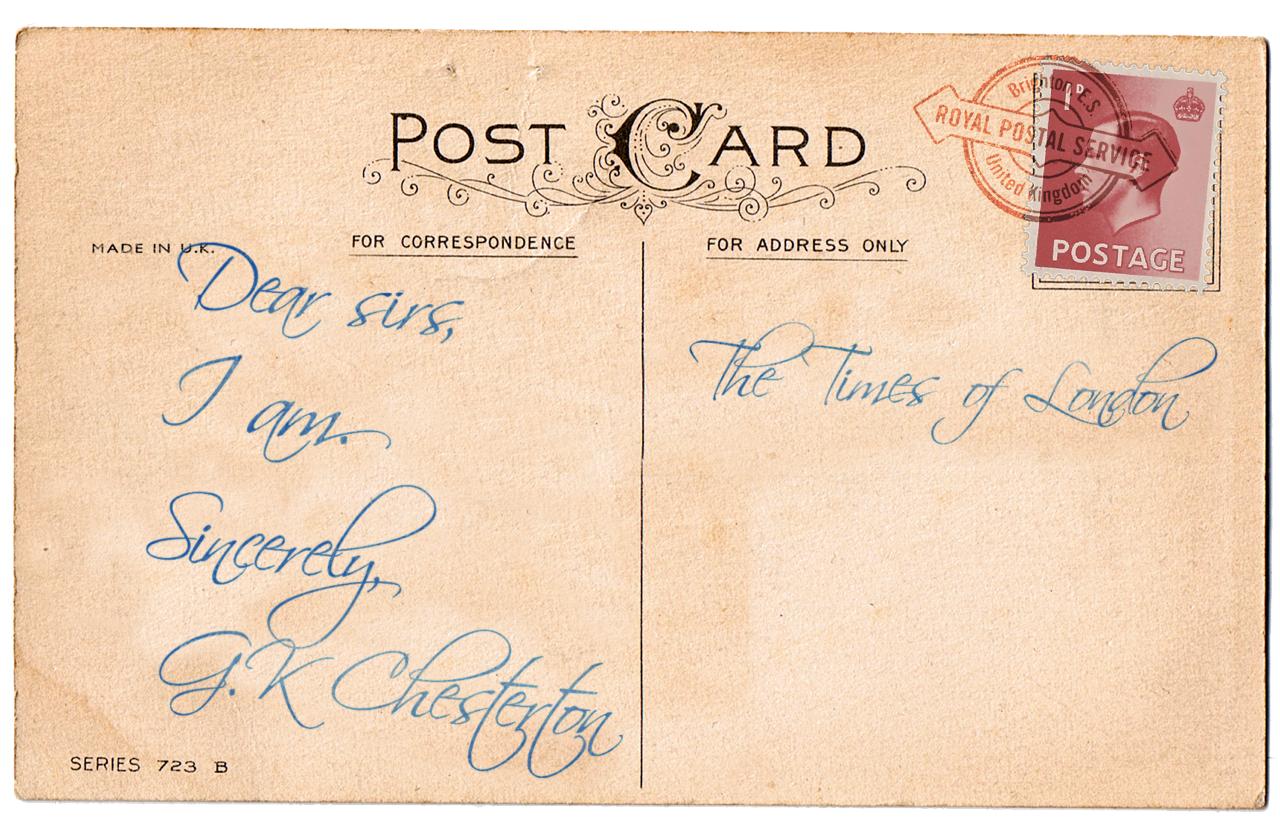
The Times of London once asked leading British intellectuals to write an essay answering this question, “What is wrong with the world?” G. K. Chesterton responded with a postcard,

     Dear Sirs,
     I am.
     Sincerely yours,
     G.K. Chesterton

I think that’s right. He is the problem. I mean, I am. (The former slips out so easily, doesn’t it? Isn’t the problem with the world everybody else?)

Chesterton’s response challenges our modern Self-esteem philosophy. We’re taught to build up our self-esteem, to feel we are worthwhile, to believe in our value.

Yet cracks are forming in the self-esteem movement. Loren Slater, a psychologist and writer, wrote a critique of self-esteem. In it she says,

There is enough evidence from 20 years of studies to conclude that people with high self-esteem pose a greater threat to people around them than people with low self-esteem, and low self-esteem is not the source of any of our country’s biggest problems. (The Problem With Self-Esteem)

I think Chesterton would agree with Slater’s observation, that “low self-esteem is not the source of any of our country’s biggest problems.”

Because we are.

Grasping for self-esteem (or self-worth) is a way of trying to get glory from something other than God, and it always, inevitably, fails miserably. Let’s look at two examples from scripture. Continue Reading…

A few weeks ago I met a twenty-eight-year-old woman who told me of a struggle. Growing up, she longed for a good husband, a nice family, and a moderate house.

Shortly after college, she married a really good man. They found good jobs in their fields. They bought a nice house. A year later they got pregnant and had a healthy baby.

She had all she had wanted but she still felt restless.

They bought a newer car. They repainted the house. They added granite countertops; then stainless steel appliances. They were promoted. Her husband got an MBA. She quit her job and become a full-time mother. It felt good but the satisfaction didn’t last.

Soon, again, she felt discontent and restlessness. She asked herself, “Is this all there is?” She saw the same restlessness in her friends. Then she read an Einstein quote, “Insanity is doing the same thing over and over, and expecting a different result.

She said, “I wonder if we’re all spiritually insane.” Continue Reading…

Several years ago I met with a woman distraught by her son’s rejection of Christianity.

She said, “I did everything I could to raise him right. I taught him to be like the ‘heroes of faith,’ with the faithfulness of Abraham, the goodness of Joseph, the pure heart of David, and the obedience of Esther.”

She wondered why he rejected Christianity.

I wondered why it took him so long. Continue Reading…